

Diagnostic Imaging Market to reach USD 134.75 Billion by 2035 at 4.80% CAGR
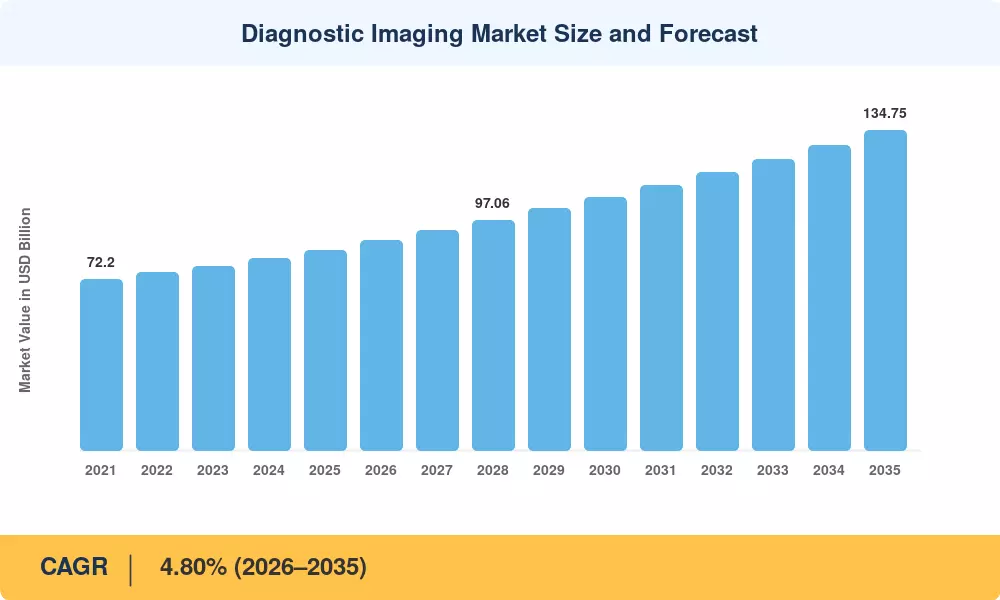
Diagnostic Imaging Market (2026 - 2035)
Diagnostic Imaging Market to Surge from USD 84.40 Billion in 2025 to USD 134.75 Billion by 2035—Powered by Aging Populations, Government Screening Mandates
NY, CA, UNITED STATES, August 31, 2026 /EINPresswire.com/ -- As per Market Research Future, the global Diagnostic Imaging Market size reached an estimated USD 84.40 Billion in 2025 and is projected to reach USD 134.75 Billion by 2035, at a CAGR of 4.80% during the forecast period 2026–2035. From a 2026 starting value of USD 88.41 Billion, the market is set for sustained expansion.The 4.80% CAGR—anchored by structural shifts in radiology and medical device deployment—is propelled by three converging forces: the aging global population and rising chronic disease burden, with the WHO estimating that adults aged 65 and older will double to 1.6 billion globally by 2050, sharply raising demand for cancer, cardiovascular, and neurological imaging; government mandates around early cancer detection, including the European Commission's Beating Cancer Plan targeting 90% breast-screening coverage by 2025 and CMS reimbursement expansions for low-dose CT lung screening in the United States, anchoring demand at scale; and the rapid integration of AI and machine learning into image reconstruction, with the FDA clearing over 900 AI-enabled medical-device algorithms as of early 2025, with radiology accounting for roughly 75% of those clearances, reducing MRI scan times by up to 50% and CT noise by 40%.
Global medical device companies and health organizations are amplifying this momentum. GE HealthCare holds an estimated 14–18% revenue share with the broadest modality portfolio spanning Revolution CT, SIGNA MRI, and the AI Edison platform. Siemens Healthineers commands approximately 14–17% share with its technology leadership in spectral CT through the NAEOTOM Alpha photon-counting platform. Philips Healthcare holds approximately 10–13% with its AI-first workflow integration and ambulatory focus. The next platform change for the Diagnostic Imaging Market is photon counting CT, which gathers spectral energy data in a single acquisition and drew over USD 1.2 billion in combined R&D spend across key OEMs between 2022 and 2025. These forces are creating the clinical infrastructure and patient demand on which the Diagnostic Imaging Market depends.
Request A Free Sample:
https://www.marketresearchfuture.com/sample_request/6765
Key Market Trends & Growth Drivers
Aging Population and Chronic Disease Burden
The market is witnessing increasing demand driven by demographic shifts. The WHO estimates that adults aged 65 and older will double to 1.6 billion globally by 2050, sharply raising demand for cancer, cardiovascular, and neurological imaging. In the United States alone, CMS projects Medicare imaging expenditures will grow 6–8% annually through 2030 as the baby-boomer cohort enters peak-utilization years, directly expanding the Diagnostic Imaging Market revenue base. This trend indicates a structural shift in healthcare utilization, with diagnostic imaging being recognized as essential for early detection and longitudinal disease management. GE HealthCare continues advancing product development through next-generation CT and MRI platforms while strengthening strategic partnerships supporting hospital capital-expenditure cycles.
AI/ML Integration in Image Reconstruction
Innovations in artificial intelligence are becoming a hallmark of the industry. The FDA has cleared over 900 AI-enabled medical-device algorithms as of early 2025, with radiology accounting for roughly 75% of those clearances. Deep-learning reconstruction reduces MRI scan times by up to 50% and CT noise by 40%, enabling higher patient throughput without additional hardware — a powerful economics driver for the Diagnostic Imaging Market. These advancements aim to enhance radiologist productivity and diagnostic accuracy, potentially leading to better health outcomes and increased market penetration. AI-assisted triage can shorten critical-finding turnaround by 30–45 minutes, creating a software-revenue layer on top of hardware sales.
Government Screening Mandates
The incorporation of population-level screening programs into national health policy is gaining traction. The European Commission's Beating Cancer Plan requires member states to offer breast, cervical, and colorectal screening to 90% of eligible populations by 2025, creating procurement waves for mammography and CT colonography equipment. India's Ayushman Bharat Digital Mission is similarly catalyzing radiology infrastructure in district hospitals, expanding addressable sites for the Diagnostic Imaging Market across tier-2 and tier-3 cities. Tools such as mobile applications and telehealth services are being utilized to monitor screening compliance and facilitate communication between healthcare providers and patients, enhancing treatment outcomes.
Photon-Counting Detector Commercialization
The transition from energy-integrating to photon-counting CT detectors is a primary driver. Photon-counting CT gathers spectral energy data in a single acquisition, drew over USD 1.2 billion in combined R&D spend across key OEMs between 2022 and 2025, and is forecast to expand CT modality revenue at a 6.8% CAGR through 2035. This technology delivers spectral data without dual-scan protocols, decreasing scan durations by 30–50% and reducing radiation dose. The market is projected to expand as healthcare providers increasingly adopt next-generation imaging systems to manage chronic conditions. Regulatory bodies like the FDA and EMA are actively facilitating the approval of new detector technologies.
Ask for Customization:
https://www.marketresearchfuture.com/ask_for_customize/6765
Market Segment Insights
BY MODALITY
X-Ray: Largest segment with 27.1% share in 2025, driven by high-volume emergency and orthopedic use cases across hospital and outpatient settings. Fujifilm Healthcare continues expanding digital radiography portfolios through sustained product innovation.
Computed Tomography: Fastest-growing modality at 6.8% CAGR, driven by photon-counting detector adoption and AI-assisted triage protocols. Siemens Healthineers leads with its NAEOTOM Alpha platform.
MRI: Positioned as a high-value segment, projected to surpass USD 22.50 Billion by 2035, as ultra-high-field and helium-free magnet designs lower lifecycle costs.
BY APPLICATION
Diagnostic Imaging: Largest segment with 62.1% share in 2025, spanning oncology, cardiology, and musculoskeletal evaluations. GE HealthCare continues strengthening diagnostic imaging portfolios through AI Edison platform expansion.
Therapeutic & Interventional: Fastest-growing application at 7.1% CAGR, fueled by image-guided surgery and minimally invasive procedures.
Research & Clinical Trials: Smaller but significant share at USD 4.80 Billion in 2025, reflecting pharmaceutical imaging endpoints and biomarker validation demand.
BY END USER
Hospitals: Largest segment with 57.2% share in 2025, leveraging multimodality suites integrated with electronic health records. Siemens Healthineers continues strengthening hospital distribution through portfolio expansion.
Diagnostic Imaging Centers: Fastest-growing end-user segment at 7.6% CAGR, as payers steer referrals toward lower-cost freestanding sites.
Others (Clinics, Research Labs): Significant share at USD 6.90 Billion in 2025, driven by specialty clinics and academic research demand.
BY PRODUCT TYPE
Standalone Imaging Systems: Dominant product type, reflecting high-volume deployment across hospital and outpatient settings.
Software Solutions: Fastest-growing product segment, driven by AI-powered clinical decision support, cloud-based PACS platforms, and image analytics monetization.
Mobile Imaging Systems: Emerging opportunity, with handheld ultrasound devices priced below USD 5,000 opening primary-care screening markets in Sub-Saharan Africa and rural Southeast Asia.
Read Detailed Insights:
https://www.marketresearchfuture.com/reports/diagnostic-imaging-market-6765
Regional Outlook
North America — Market Leader in Innovation
North America leads with 44.9% of global revenue in 2025, generating the largest regional share. The region's growth is driven by a dense installed base, favorable reimbursement policies, and technology-forward health systems. According to CMS, Medicare imaging expenditures are projected to grow 6–8% annually through 2030. The competitive landscape is characterized by continuous innovation and strategic partnerships among leading medical device companies.
Europe — Second Largest Market
Europe holds a 23.5% share in 2025, representing the second-largest regional market. The region benefits from cross-border procurement procedures, dose-reduction mandates, and supportive healthcare policies. The UK's NHS committed GBP 2.3 billion to its Community Diagnostic Centre program through 2025, directly expanding the Diagnostic Imaging Market footprint outside traditional hospital settings. Regulatory bodies like the EMA are actively facilitating the approval of new imaging technologies. Leading countries include Germany, the United Kingdom, and France, where major companies such as Siemens Healthineers and Philips Healthcare are heavily invested.
Asia-Pacific — Rapidly Growing Market Segment
The Asia-Pacific region accounts for approximately 21.8% of the global share and is the fastest-growing region at 5.9% CAGR. The growth is driven by government hospital development plans in India, China, and Southeast Asia. China's 14th Five-Year Plan allocated over CNY 200 billion to county-level hospital upgrades, creating a procurement pipeline for mid-range CT and ultrasound systems from domestic manufacturers such as Mindray and United Imaging. India's Ayushman Bharat Digital Mission is linking 150,000+ health facilities to a national health-information exchange that requires digitized imaging. The competitive landscape is evolving with companies like Canon Medical Systems and Fujifilm Healthcare leading the charge.
South America — Emerging Opportunity
The South America region holds around 4.6% of the global share, driven by public-health infrastructure investment and rising healthcare access. Brazil's Unified Health System continues to procure digital X-ray and ultrasound systems for primary-care units. Refurbished equipment channels account for an estimated 25–30% of installed capacity in the region. Countries like Brazil and Argentina are leading the way, with a growing presence of international medical device companies.
Middle East and Africa — Untapped Potential
The MEA region holds around 5.2% of the global share, driven by PPP hospital projects, mobile imaging deployment, and rising healthcare investments. Saudi Arabia's Vision 2030 earmarked over USD 65 billion for health-sector transformation, including 20 new hospitals requiring full imaging-suite commissioning. The United Arab Emirates is advancing as a medical-tourism hub. These mega-projects are a direct growth lever for the Diagnostic Imaging Market across the Gulf Cooperation Council states.
Competitive Landscape and Recent Developments
The Diagnostic Imaging Market is characterized by intense competition and steady growth, driven by increasing prevalence of chronic diseases and aging populations worldwide. The global industry appears moderately concentrated, with the top five companies anticipated to hold a combined revenue share of 55–65%.
KEY COMPANIES AND RECENT MILESTONES
GE HealthCare (US) (December 2021): Launched the Revolution Apex CT platform featuring a deep-learning image-reconstruction engine designed to cut scan times by 40%. Holds an estimated 14–18% revenue share with the broadest modality portfolio and strong service network.
Siemens Healthineers (DE) (September 2021): Received expanded FDA clearance for NAEOTOM Alpha photon-counting CT across cardiac and oncology indications, reinforcing its technology lead in the Diagnostic Imaging Market. Holds approximately 14–17% revenue share.
Philips Healthcare (NL): Commands approximately 10–13% share with its AI-first workflow integration, Spectral CT 7500, SmartSpeed MRI, and Lumify ultrasound platforms, maintaining an ambulatory-focused strategic positioning.
Fujifilm Healthcare (JP) (July 2021): Completed integration of Hitachi's diagnostic imaging business, adding MRI and CT modalities to its portfolio and expanding its Diagnostic Imaging Market footprint. Holds approximately 5–8% revenue share with digital X-ray leadership.
Other Key Players: Canon Medical Systems (JP), Hologic Inc. (US), Shimadzu Corporation (JP), Mindray Medical (CN), Samsung Electronics (KR), Carestream Health (US).
Future Outlook: 2026–2035
The Diagnostic Imaging Market is projected to reach USD 134.75 billion by 2035, growing at a CAGR of 4.80%, driven by aging populations, rising chronic disease burdens, and advancements in AI-enabled workflows and value-based reimbursement models.
New opportunities lie in:
AI-powered clinical decision support and autonomous imaging workflows
Theranostics and companion diagnostic imaging convergence in precision oncology
Mobile and handheld imaging in emerging markets and point-of-care settings
Cloud-based image analytics and data monetization through federated learning
Pay-per-scan and managed-equipment-service contracts expanding addressable markets
Sustainability and green imaging initiatives with helium-free MRI and low-power digital detectors
By 2035, the Diagnostic Imaging Market is expected to achieve substantial growth and innovation, with market leadership belonging to OEMs that successfully bundle AI software subscriptions with hardware platforms and demonstrate lifecycle environmental performance.
More Related Research Insights:
https://www.marketresearchfuture.com/reports/bispecific-antibodies-market-21846
https://www.marketresearchfuture.com/reports/orthopedic-implant-market-838
https://www.marketresearchfuture.com/reports/respiratory-care-devices-market-6517
https://www.marketresearchfuture.com/reports/ai-drug-discovery-market-9393
https://www.marketresearchfuture.com/reports/hernia-repair-market-2287
https://www.marketresearchfuture.com/reports/hospital-furniture-market-1007
https://www.marketresearchfuture.com/reports/homeopathic-medicine-market-4411
https://www.marketresearchfuture.com/reports/renal-dialysis-market-1409
https://www.marketresearchfuture.com/reports/intrathecal-pumps-market-11507
https://www.marketresearchfuture.com/reports/antacid-market-8915
Market Research Future
Market Research Future
+1 855-661-4441
email us here
Legal Disclaimer:
EIN Presswire provides this news content "as is" without warranty of any kind. We do not accept any responsibility or liability for the accuracy, content, images, videos, licenses, completeness, legality, or reliability of the information contained in this article. If you have any complaints or copyright issues related to this article, kindly contact the author above.
