

Medical Billing Outsourcing Market to reach USD 33.89 Billion by 2035 at 10.35% CAGR
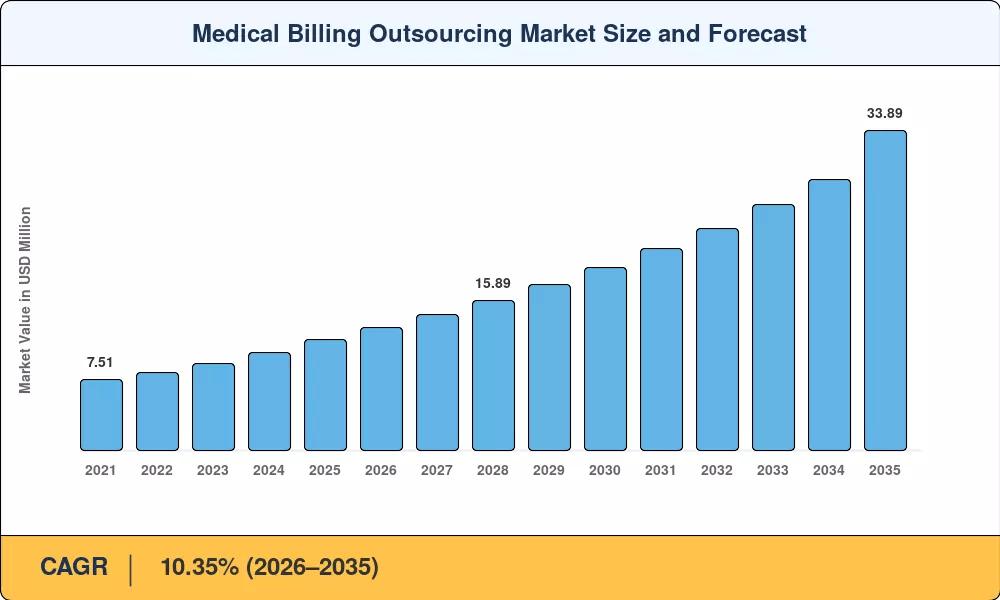
Medical Billing Outsourcing Market Size
Medical Billing Outsourcing Market to Surge from USD 13.05 Billion in 2026 to USD 33.89 Billion by 2035- By AI Revenue Cycle Automation, ICD Coding Complexity
NY, CA, UNITED STATES, June 8, 2026 /EINPresswire.com/ -- As per Market Research Future, the global Medical Billing Outsourcing Market size to reach USD 33.89 Billion by 2035 from USD 13.05 Billion in 2026, at a CAGR of 10.35% during the forecast period 2026--2035. The market base was estimated at USD 11.76 Billion in 2025.The 10.35% CAGR---nearly double the growth rate of the broader healthcare IT sector---is driven by three converging structural forces: the regulatory acceleration of CMS reimbursement models and the No Surprises Act (2022) imposing tighter compliance deadlines on claims transparency, the emergence of AI-native revenue cycle management platforms capable of auto-assigning ICD and CPT codes with 96% accuracy, and the global shift from on-premise billing engines to cloud-native SaaS platforms that embed predictive denial management and real-time eligibility verification.
National governments are amplifying this momentum. The U.S. Department of Health & Human Services reported that improper payment rates for Medicare fee-for-service reached 7.46% in 2024---roughly USD 51.1 billion in incorrect claims---with coding errors accounting for the majority. Revenue cycle management spending among U.S. hospitals alone exceeded USD 115 billion in 2024, with outsourced billing capturing an increasing slice of that total. India's Ayushman Bharat Digital Mission seeks to digitize health records for 500 million residents by 2028, while Indonesia's JKN universal coverage program handles about 270 million claims per year. Together, these initiatives are creating the institutional frameworks on which third-party billing services and healthcare claims processing depend.
Request A Free Sample: https://www.marketresearchfuture.com/sample_request/7621
Key Market Trends & Growth Drivers
Regulatory Complexity and Coding Transitions
The transition from ICD-10-CM to ICD-11, scheduled for broad U.S. adoption by 2027, will expand the code set from approximately 72,000 to over 80,000 entries. This complexity makes ICD coding outsourcing essential for providers lacking in-house expertise and is the single largest structural driver of the Medical Billing Outsourcing Market through 2035. CMS reported that improper payment rates for Medicare fee-for-service reached 7.46% in 2024---roughly USD 51.1 billion in incorrect claims---with coding errors accounting for the majority. Third-party billing services with specialized coding teams reduce these error rates by 30--40%, making outsourcing a financial necessity rather than a convenience.
Early-adopter health systems report that the No Surprises Act (2022) and subsequent CMS price transparency mandates have added compliance layers that favor specialized third-party billing services over stretched internal teams. The CY2025 Physician Fee Schedule introduced 12 new CPT codes and revised E/M documentation requirements, increasing outsourcing demand for coding specialization.
AI and Automation in Revenue Cycle Management
Artificial intelligence is transforming healthcare claims processing from a labor-intensive back-office function into a data-driven operation. Natural language processing engines now auto-assign ICD and CPT codes with 96% accuracy, while predictive analytics flag likely denials before submission. A 2024 HFMA study found that health systems deploying AI-augmented revenue cycle management platforms improved first-pass acceptance rates from 82% to 94% and reduced cost-to-collect by USD 4.80 per claim. Vendors investing in AI-powered revenue cycle management platforms have demonstrated up to 37% reductions in claim denial rates and 25-day improvements in days-in-accounts-receivable.
McKinsey projects that generative AI could unlock USD 200--360 billion in annual healthcare administrative savings globally by 2032. By 2030, an estimated 40% of routine claims in the Medical Billing Outsourcing Market will be processed end-to-end without human intervention. Platforms from companies such as Optum and R1 RCM can analyze multi-payer claim profiles and deliver predictive denial management within 48 hours---compressing timelines that previously required weeks of manual review.
Workforce Shortages in Medical Coding
The AAPC's 2024 workforce survey estimated a U.S. shortfall of 30,000 certified medical coders, with annual turnover rates exceeding 22% at hospital billing departments. Average biller salaries rose 14% between 2022 and 2024, further pressuring in-house cost structures. These dynamics push providers toward outsourced ICD coding outsourcing partners who can distribute workloads across global talent pools---particularly in India and the Philippines, where certified coder availability has grown 18% year-on-year.
In February 2026, Optum launched an AI-powered prior authorization engine, reducing approval turnaround from 14 days to 48 hours across its third-party billing services clients---a milestone illustrating how workforce shortage mitigation is directly accelerating revenue cycle management commercialization. GeBBS Healthcare Solutions expanded its Hyderabad campus in June 2024 to accommodate 3,000 additional coders, responding to surging demand for offshore ICD coding outsourcing.
Ask for Customization: https://www.marketresearchfuture.com/ask_for_customize/7621
Market Segment Insights
BY SERVICE TYPE
Front-End Services: Dominant segment with ~45.87% share in 2025. Patient registration, insurance verification, and prior authorization anchor demand; getting eligibility verification right at intake prevents 60--70% of downstream denials. Healthcare claims processing vendors have invested heavily in real-time eligibility APIs that connect to over 1,200 U.S. payer systems simultaneously.
Middle-End Services: Fastest-growing segment at 11.38% CAGR (2026--2035). ICD coding outsourcing and charge capture drive demand; the shift to risk-adjusted payment models under Medicare Advantage means that coding accuracy directly impacts reimbursement levels, making specialized coding partners indispensable.
Back-End Services: USD 2.94 Billion revenue in 2025. Payment posting, accounts receivable follow-up, and denial management sustain baseline demand; vendors embedding predictive analytics flag likely denials before submission.
Other Services (Credentialing, Compliance, Analytics): 9.5% CAGR (2026--2035), representing next-generation revenue integrity and benchmarking frontiers.
BY DEPLOYMENT TYPE
Cloud-Based: Dominant deployment with ~56.65% share in 2025. SaaS scalability and remote workforce enablement drive demand; providers prioritize operational flexibility and capital expenditure avoidance. By 2025, 57% of newly signed outsourcing contracts specified cloud-native delivery, up from 38% in 2022.
On-Premise: 8.72% CAGR (2026--2035). Legacy EHR integration and data sovereignty requirements sustain demand among large health systems with established infrastructure; on-premise billing infrastructure requires capital expenditures averaging USD 1.2 million for a mid-sized hospital.
Hybrid: USD 1.18 Billion in 2025, driven by providers seeking phased cloud migration while maintaining critical on-premise systems for data sovereignty.
BY END USER
Hospitals: Dominant end user with ~51.82% share in 2025. Multi-payer complexity and high claim volumes anchor demand; a typical 400-bed hospital generates over 250,000 claims annually across dozens of payers, making in-house revenue cycle management increasingly untenable.
Physicians' Offices: USD 2.82 Billion in 2025. Administrative burden reduction drives outsourcing adoption among solo and group practices managing relationships with over 900 distinct commercial and government payers on average.
Ambulatory Surgery Centers & Other Providers: Fastest-growing end user at 10.72% CAGR. Outpatient volume growth and ASC expansion fuel demand as procedures shift from hospital settings to lower-cost facilities.
Diagnostic Labs & Specialty Clinics: ~8% share; specialized billing for laboratory and pathology services remains a foundational demand driver.
Regional Outlook
North America --- Dominant Market (~45.72% Share, 2025)
The United States generates approximately 82.5% of North American Medical Billing Outsourcing Market revenue, driven by Medicare/Medicaid complexity, the No Surprises Act compliance requirements, and the average hospital managing relationships with over 900 distinct commercial and government payers. Revenue cycle management spending among U.S. hospitals alone exceeded USD 115 billion in 2024, with outsourced billing capturing an increasing slice of that total. Canada is growing at 10.18% CAGR on provincial billing modernization, contributing 11.5% of regional revenue. Mexico's INSABI-to-IMSS-Bienestar transition contributes USD 0.21 billion in 2025.
Europe --- Second Largest (USD 2.65 Billion, 2025)
Europe's Medical Billing Outsourcing Market benefits from the EU's European Health Data Space regulation (2024) standardizing cross-border claims exchange formats, reducing localization costs for pan-European billing vendors. Germany leads regionally with 28.3% of regional share through DRG reform and statutory health insurance billing. The UK contributes USD 0.52 billion anchored by NHS outsourcing framework agreements. France is growing at 9.45% CAGR on Sécurité sociale digital claims modernization. Italy holds USD 0.22 billion with SSN regional billing fragmentation. Spain is growing at 8.91% CAGR on public-private partnership expansion. Nordic Countries contribute USD 0.18 billion through cross-border EU billing harmonization.
Asia-Pacific --- Fastest-Growing Region (11.92% CAGR, 2026--2035)
Asia-Pacific is the highest-growth corridor in the Medical Billing Outsourcing Market. India holds 34.6% of regional share as the global epicenter for offshore healthcare claims processing, with cities like Hyderabad and Chennai hosting over 200 specialized billing operations employing more than 150,000 certified coders. The region benefits from a 60--70% labor cost advantage compared to U.S.-based operations. China is growing at 12.35% CAGR on National Healthcare Security Administration reforms. Japan contributes USD 0.31 billion through aging population DPC billing complexity. South Korea is growing at 10.88% CAGR on HIRA claims digitization. ASEAN contributes USD 0.24 billion through universal coverage programs in Indonesia and Thailand. The region accounted for USD 1.40 Billion in 2025.
South America --- Growing Presence (USD 0.62 Billion, 2025)
Brazil anchors South America's Medical Billing Outsourcing Market at ~58.2% of regional revenue, with the unified health system (SUS) processing 3.8 billion procedures in 2024. Claim rejection rates of 18% signal a significant opportunity for third-party billing services specializing in public-payer revenue cycle management. Argentina is growing at 9.22% CAGR on Obras sociales system complexity. Gradual insurance formalization across the rest of South America supports steady growth.
Middle East & Africa --- Emerging Opportunity (9.85% CAGR, 2026--2035)
Saudi Arabia's Council of Cooperative Health Insurance has mandated electronic claims submission for all providers since 2023, driving rapid uptake of outsourced healthcare claims processing among private hospital groups and accounting for 35.8% of regional share. The UAE is growing at 10.42% CAGR on DHA and HAAD claims standardization. South Africa contributes USD 0.09 billion through medical scheme billing complexity. Egypt is growing at 11.05% CAGR on Universal Health Insurance Law rollout. Early-stage insurance development across the rest of MEA creates incremental opportunities as mandatory health insurance rollouts expand.
Read Detailed Insights: https://www.marketresearchfuture.com/reports/medical-billing-outsourcing-market-7621
Competitive Landscape and Recent Developments
The Medical Billing Outsourcing Market exhibits low concentration, with the top five players collectively holding an estimated 28--35% of global revenue. The Herfindahl-Hirschman Index sits below 600, confirming a fragmented landscape where regional specialists, offshore pure-plays, and technology-first disruptors compete alongside established revenue cycle management conglomerates.
The competitive landscape is stratified between large-platform integrators controlling end-to-end revenue cycle and analytics workflows, mid-sized specialty firms focused on specific provider types, and AI-native disruptors reshaping coding economics through autonomous claim processing. Between 2023 and 2025, over USD 12 billion in M&A transactions reshaped the third-party billing services sector.
KEY COMPANIES AND RECENT MILESTONES
Optum (UnitedHealth Group) (February 2026): Launched an AI-powered prior authorization engine, reducing approval turnaround from 14 days to 48 hours across its third-party billing services clients. Estimated revenue share: ~7--10% of global Medical Billing Outsourcing Market.
R1 RCM (June 2022): Completed integration of Cloudmed acquisition, creating a combined entity with USD 2.4 billion in managed net patient revenue. The deal strengthens R1's analytics capabilities for revenue cycle management. Estimated revenue share: ~5--8%.
Oracle Health / Cerner (September 2024): Released a FHIR-native billing module integrated with its Cerner Millennium EHR, enabling seamless healthcare claims processing for 500+ hospital clients. Estimated revenue share: ~2--3%.
GeBBS Healthcare Solutions (June 2024): Expanded its Hyderabad campus to accommodate 3,000 additional coders, responding to surging demand for offshore ICD coding outsourcing. Estimated revenue share: ~3--5%.
FinThrive (March 2022): Rebranded from nThrive and launched its Revenue Operating System platform, consolidating patient access, claims, and analytics into a unified cloud-based revenue cycle management solution. Estimated revenue share: ~2--3%.
AGS Health (November 2024): Expanded AI-augmented coding accuracy offerings, targeting 37% reduction in claim denial rates through predictive analytics integration. Estimated revenue share: ~2--4%.
Future Outlook: 2026--2035
By 2030, AI-driven autonomous revenue cycles are expected to process over 40% of routine claims in the Medical Billing Outsourcing Market without human intervention, integrating natural language processing engines, predictive denial analytics, and automated payment posting into unified clinical dashboards. Autonomous revenue cycle management---from patient scheduling and eligibility verification through coding, submission, and payment posting---will become the standard offering from tier-one vendors. McKinsey projects that generative AI could unlock USD 200--360 billion in annual healthcare administrative savings globally by 2032.
The next decade will see market consolidation around platform ecosystems where billing, credentialing, prior authorization, and analytics converge. Providers will increasingly select a single outsourcing partner for the entire revenue cycle rather than managing point solutions. Between 2023 and 2025, over USD 12 billion in M&A transactions reshaped the third-party billing services sector, and the trajectory points toward integrated platform economics.
Post-Change Healthcare, cybersecurity has moved from a checkbox to a differentiator. Vendors investing in SOC 2 Type II, HITRUST CSF, and zero-trust frameworks will command premium positioning in the Medical Billing Outsourcing Market. By 2028, 70% of new outsourcing contracts will include mandatory cyber-insurance provisions and real-time threat monitoring SLAs. As CMS pushes toward 100% value-based contracts by 2030, outsourcing vendors must evolve beyond fee-for-service claims processing. Insurance reimbursement services will need to incorporate quality measure tracking, risk adjustment coding, and outcomes-based analytics, driving the Medical Billing Outsourcing Market to its USD 33.89 Billion 2035 destination.
More Related Research Insights:
https://www.marketresearchfuture.com/reports/revenue-cycle-management-market-18856
https://www.marketresearchfuture.com/reports/healthcare-bpo-market-1335
https://www.marketresearchfuture.com/reports/medical-coding-market-10767
https://www.marketresearchfuture.com/reports/healthcare-it-market-5950
https://www.marketresearchfuture.com/reports/ehr-emr-market-819
https://www.marketresearchfuture.com/reports/healthcare-claims-management-market-6376
https://www.marketresearchfuture.com/reports/healthcare-analytics-market-7819
https://www.marketresearchfuture.com/reports/practice-management-system-market-29471
https://www.marketresearchfuture.com/reports/telehealth-market-900
https://www.marketresearchfuture.com/reports/hospital-information-system-market-10732
Larry Wilson
WantStats Research And Media Pvt. Ltd.
+1 855-661-4441
email us here
Visit us on social media:
LinkedIn
Facebook
YouTube
X
Legal Disclaimer:
EIN Presswire provides this news content "as is" without warranty of any kind. We do not accept any responsibility or liability for the accuracy, content, images, videos, licenses, completeness, legality, or reliability of the information contained in this article. If you have any complaints or copyright issues related to this article, kindly contact the author above.
